Sunday, 8 July 2012

Auf Wiedersein Deutscheland…Ciao Roma


Our trip back to Rome is totally without incident – just the way we like it.  The plane was a few minutes late leaving Dresden and we didn’t have any spare time in Munich as our flight was boarding when we arrived at the gate.  This time our luggage arrived with us and after we collected it we caught the train from Rome’s Fiumicino Airport to Roma Termini station.  This time there was a blitz on ticket verification and there were inspectors checking tickets before travellers boarded the train and again when they got off in Rome.

We found the Hotel Corona where we’ll be staying while we’re in Rome.  It’s quite close to the station – only about a 5 minute walk.  The reception area to this hotel is not very impressive but the room is comfortable and the bathroom is modern and clean.  There’s enough room for us as we don’t plan to be spending too much time in the room except for sleeping.  There are quite a few restaurants nearby so we won’t starve (no chance of starvation on this trip – the food is great!!).  Nearby we have the opera theatre and some museums which we’ll be checking out over the next few days.


Our internet and mobile reception has been slow and intermittent in Barenfels, certainly not good enough to update this blog, which is why there haven’t been any posts over the past week.  We’re making up for it now we’re in Rome.

Back in Barenfels


Friday is a quiet day.  We’ve had a busy week here and there’s plenty more to see.  Inga and Phill have been here a few times, this is their 4th visit, and we can see why they keep coming back.  It such a pretty town and we can relax or be as busy as we like.  Today we are just relaxing.  Tomorrow we head for the airport for our trip back to the hustle, bustle and heat of Rome via Munich.  Hopefully our luggage will arrive on the plane with us.

Dresden


Thursday morning we all piled into the car for a day trip to Dresden.  The city of Dresden was totally destroyed by allied fire-bombing in February 1945 in the later stages of World War II.  Some 25,000 Dresden residents were killed together with an unknown number of refugees from eastern Europe who were living there are the time.  Following the end of the War many of the historic buildings were reconstructed using materials salvaged from the rubble.  The city now has many wide open spaces.  It straddles the River Elbe which is plied by barges and paddle-boats.  The city is easy to walk around.  Many streets are closed to cars and the cobblestoned roads and paths are flat.  We walked to the main square and entered the reconstructed cathedral which has many painted panels and a beautiful carved and painted sanctuary.  There’s a statue of Martin Luther in the square outside the cathedral.  Many of the statues have been painted gold and shine brightly in the sunlight.

In the afternoon we board the Hop on/Hop off bus for a 1½ hour tour of the city and suburbs.  We have an English commentary which is informative (although the commentator gets his right and left mixed up a bit).  Our round trip takes us past many of the historic buildings, palaces, theatres, the town hall with its golden statue with outreached arm.  Past the glass walled Volkswagon factory where the top-of-the-line Phaeton model is assembled by hand.  We drive alongside the Grosser Garten, a huge park dating back to King August I with is central avenue more than 2km long.  Then is through the high class, leafy suburb of Blasewitz where building codes determined that the house must be no more than half the width of the block of land.  Then  over the River Elbe via the Blaues Wunder (Blue Bridge) so called because it’s painted blue.  A thunderstorm hit us as we were driving through the elevated Weisser Hirsch area with its funicular to the top of the hill from the lowlands around the river.  As we drove back to the city we had some great views of the river flats with their grasslands which until recently was a World Heritage site.
Our ticket would allow us to do a couple of extra tours but by the time we get back to the city it’s time to get in the car and head for home.  Even the trip home was not without incident as we were stopped for speeding (doing 40kph in a 30kph zone).  Luckily Phill wasn’t driving as he discovered that he had left his driving licence and passport at the hotel.  Inga was let off with a warning, but of course won’t be allowed to forget her indiscretion for a while….


Sieffen


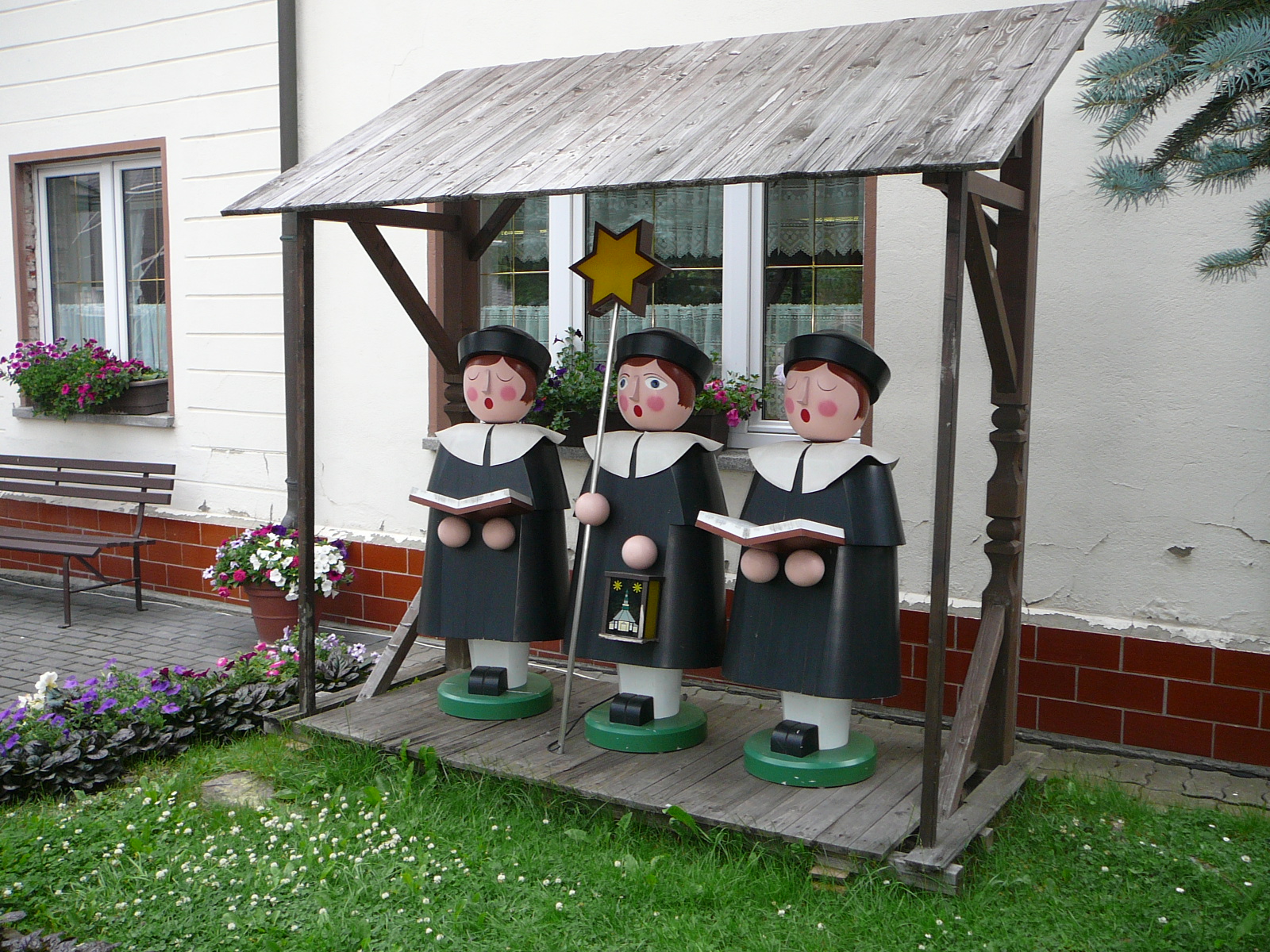
Wednesday is overcast for our day trip to Sieffen.  A visit to this town is like stepping into toytown.  The area is famous for its wooden toys and Christmas decorations.  Originally a tin mining area, as the tin deposits dried up the locals began producing wooden toys.  The nearby forests providing a ready supply of wood.  We visited the Toy Museum which traced the evolution of the industry since the 17th century to the present day.  One great innovation in the 18th century was to develop “ring carving”.  It’s difficult to explain but I’ll try.  A ring of wood is carved on both sides using a lathe.  When carving is completed, the wooden ring is sliced to reveal the toy.  About 40 items can be sliced from a single ring.  We saw many different animals, buildings and people which were carved using this method – bulk production in a cottage industry.  The shops specialize in all manner of wooden toys and blocks and intricately carved and painted Christmas decorations.  We also saw wooden chandeliers which are designed to be used with candles, some chandeliers are over a metre long and have hundreds of painted wooden balls.  Another specialty is the Christmas Pyramid, which can be anything from 10cm to 2metres high.  These pyramids are topped by a set of fan blades which are rotated by the hot air produced by a number of candles.  The fan blades in turn drive a central wooden shaft which causes the scenes on the various levels of the pyramid to rotate.  Many of the shops have a children’s play area with wooden toys and blocks to keep children occupied while adults can shop in peace.

The town also has many larger wood carvings in the parks and along the paths.  This town is very popular with tourists in the lead up to Christmas celebrations with busloads of tourists arriving at that time.  The cold snowy winter climate with the nearby forests and colourful decorations would make it very pretty.

The Bastei and Konigstein Fortress


There’s plenty to see in the nearby area.  This north-eastern area of Germany is known as “Saxon Switzerland” with its chocolate-box scenery.


The Bastei is a series of spectacular rock formations which tower 194m above the Elbe River which snakes its way through this area.  The jagged rocks have been a tourist attraction for over 200 years. There are well maintained walkways and bridges which give magnificent views over the river valley, nearby countryside and rock formations. The rocks were part of the defenses of the Neurathen Castle in the 16th century.  Evidence can be seen of medieval settlement and as we followed the path we walked past stone catapult balls.  There were signs indicating the rooms that would have been there in medieval days.  We also saw a model reconstruction of the castle.  At the base of the rocks is a natural ampitheatre which is used for performances today.  The acoustics are so good that we could clearly hear music and talking from the theatre even though we were hundreds of metres away.
From the Bastei we drove on to nearby Konigstein to see the “Mountain Fortress of Saxon Switzerland”.  We could see the fortress across the River Elbe from the Bastei.  Although geographically close it was about a 1 hour drive through narrow twisting mountain roads and river crossings are far apart.  We parked the car and bought tickets to ride up to the entrance elevator on the tourist train.  Once at the entrance we bought our entry tickets and walked through a short tunnel to the large elevator to the top of the table mountain there the fortress is located.  There is a “panoramic lift” being built which will provide spectacular views through its glass walls as patrons ride up the outside sheer rock on its completion.  Apart from the lifts, the only entrance to the fortress is via the western side of the mountain.

The fortress has had a long history in both peace and war times.  It was used as a castle 400 years ago and guests have included Tsar Peter I and Napoleon.  During World War II it was used as a prisoner of war camp for allied officers.  It’s superb defences meant that it has never been captured and there were only a handful of escapes and unauthorized entries – notably Abratzky’s Chimney which is a rock fissure from which a chimney sweep’s apprentice Sebastian Abatzky made an unauthorized entry in 1848, and the descent place of French General Henri Giraud a POW who escaped in 1942.  The flat top of the mountain has been reinforced with palisades and watchtowers.  The 9.5ha plateau has many buildings, exhibitions and parks.  The walkway around the perimeter provides panoramic views of the countryside.  There are some signs and photos showing the flooding of the River Elbe in 2002 when the town of Konigstein was under several meters of water and thousands of residents were evacuated in a very short time.  This is a place which would take several days to see all of the buildings and exhibits.  We spent several hours exploring and then caught the lift and train back to the carpark for our drive back to Barenfels.


Barenfels, Saxony


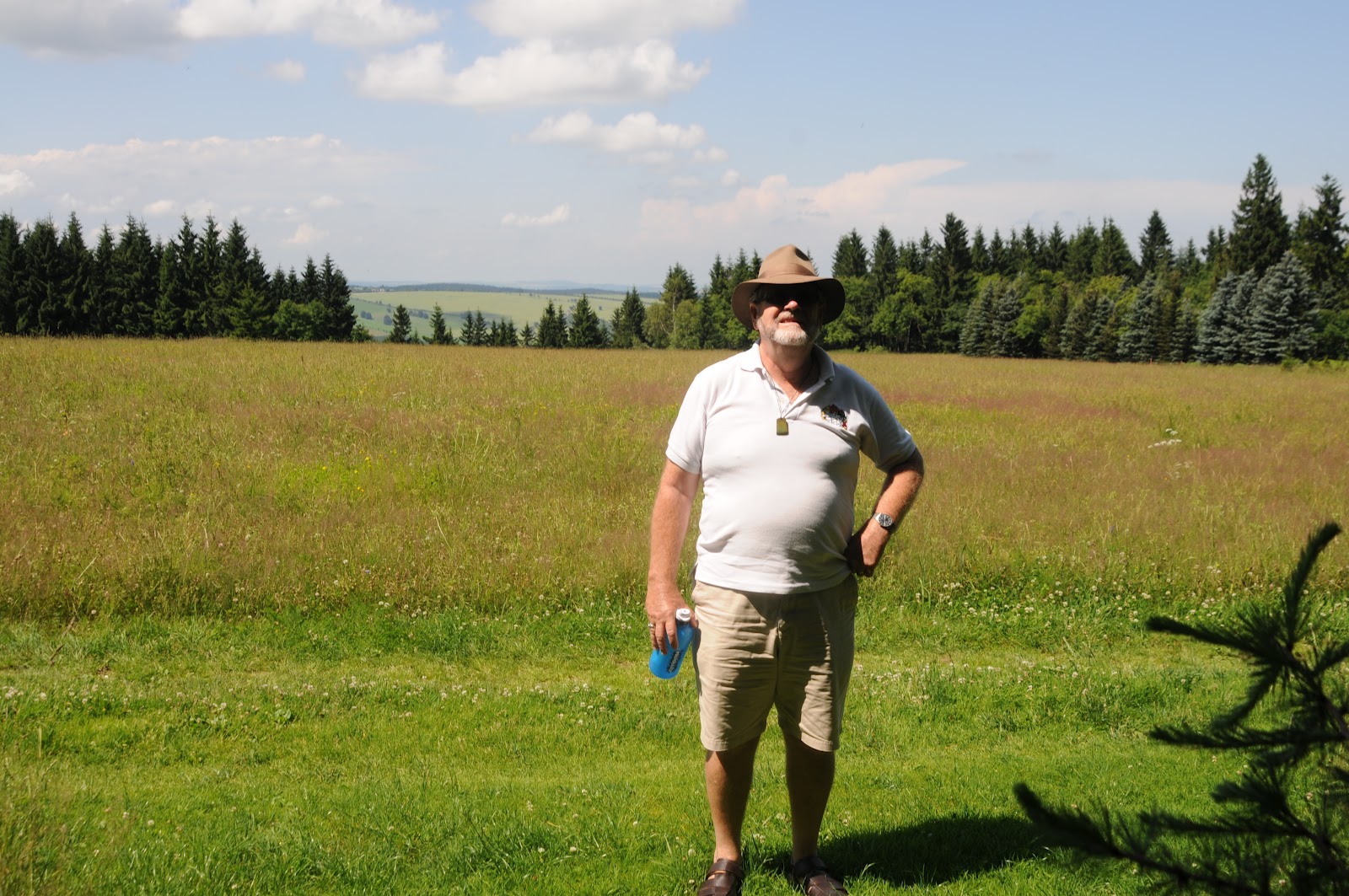
The guesthouse we are staying in is a family run business.  The owners and staff are very friendly and helpful.  Lucky for us Inga speaks very good German so we are able to make ourselves understood as we have our personal translator.  English is not widely spoken in this area which was in the DDR (East Germany) until the 1990s.  There is still plenty of evidence of the austerity days of the DDR regime although most of the infrastructure and buildings have been rebuilt.  Where there are run-down buildings this is often because there is still a dispute over ownership.  There are some empty factories around too where these businesses could not compete with the businesses from West Germany following reunification.  Barenfels is a small village.  The buildings are designed to cope with the cold snowy winters with their steep roofs, small windows, thick walls and low ceilings.  Everything is very green here and we look out over hills covered in fir trees.

Monday is a rest day for us after our travelling day on Sunday 1st July.  We are still waiting for our luggage to arrive and clean clothes will be very welcome.

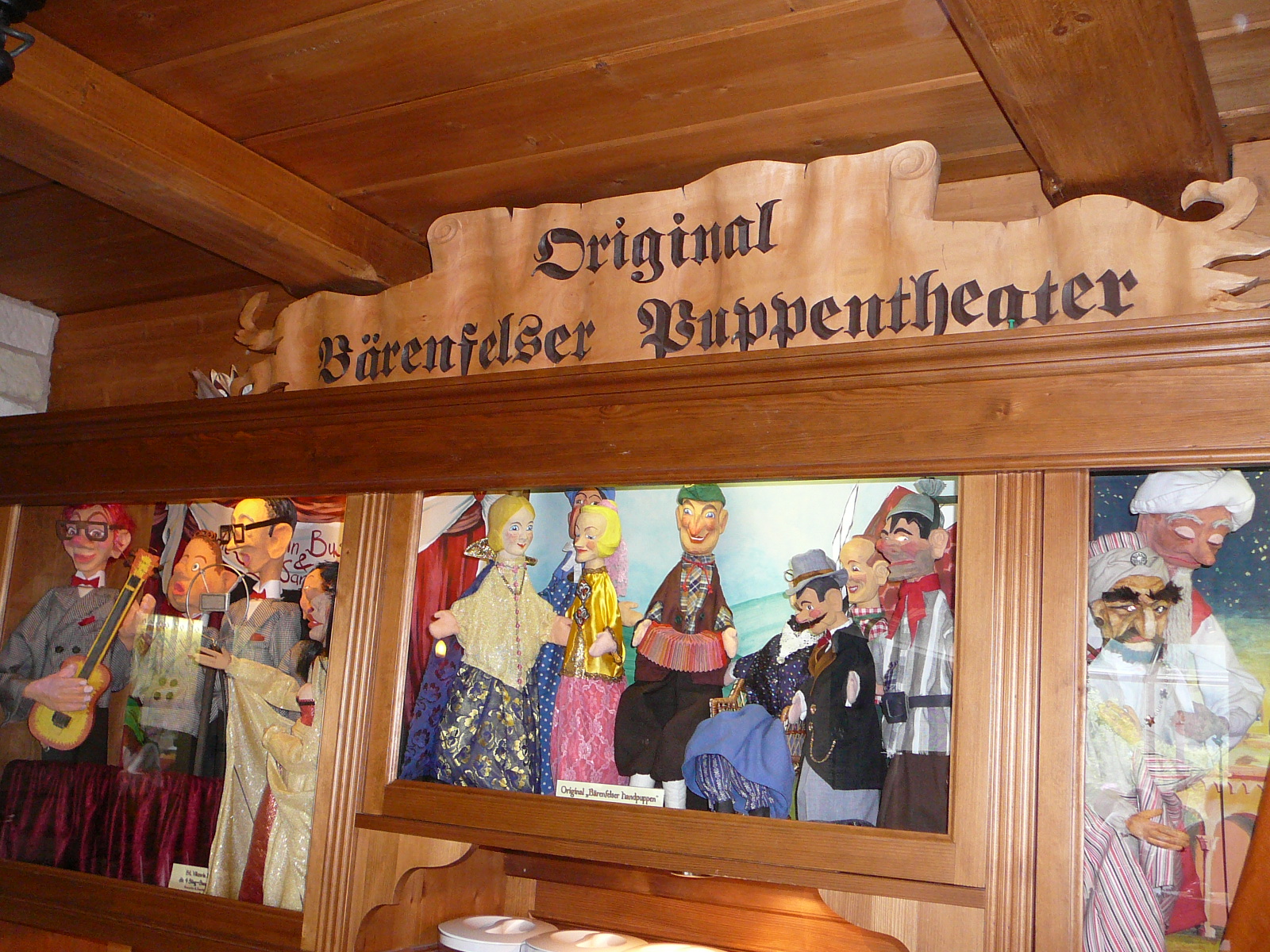
After breakfast we went for a walk through the nearby woods.  There is an education trail which we can follow which has interpretative signs explaining the different birds, plants and animals that we might see on our walk.  This area is the home to several species of owl, deer, boars, badgers, red foxes, martins and many other species of wildlife.  There are wild berries – strawberries, blueberries, blackberries and elderberries – along the way too.  After our walk through the woods we went looking for the Glockenspiel.  Inga and Phill have been looking for this on their previous visits here and we don’t manage to find it until after lunch when we are driving around.  The Glockenspiel is located in a park on a track off the road.  It consists of a number of different sized bells made from Meissen china with a striker and they play a couple of musical tunes on the hour.  We have managed to hear them a few times now.
In the afternoon we go for a drive through nearby Alpenberg which is a tourist hub in the ski season with ski-lifts and ski hire businesses.  Then it’s on to the border with the Czech Republic.  This is now an open border but there is plenty of evidence of the days when it was heavily controlled.  There are large carparks and administration buildings which are now in disrepair and are generally unused.  We venture into the Czech Republic a few hundred metres and turn around at the first roundabout.  Only Inga and Phill have their passports – ours are in our hotel room.  Shortly after returning to Germany we are pulled over by the police we had seen on our way into the Czech Republic.  They checked Inga and Phill’s passports and Phill’s driving licence and weren’t too worried that we didn’t have our passports (we did have our driving licences if they were needed as ID and we told them our passports were at the hotel).  They seemed to be pulling over all non-German registered cars coming out of the Czech Republic and they did have a good look in the back of our station wagon.

Our package here at Gasthof Barenfels includes all meals except lunch and the food is plentiful with lots of variety.  We have a continental breakfast with cold meats, cheeses, eggs, fruit, cereals, yoghurts, juices, tea and coffee.  Afternoon tea is accompanied by delicious fresh baked continental cake.  Dinner is 3 courses with an entrĂ©e of soup or salad followed by a choice of 2 main courses- we’ve had various dishes of meat, fish, noodles, vegetarian etc to choose from – followed by dessert – usually fresh fruit or pudding with icecream and cream. All meals have been delicious.  We’ve made a habit of skipping lunch.  Definitely no chance of starving here.

The guesthouse building has been here for several hundred years.  It has been completely renovated and it is very comfortable.  The dining room is light and airy with windows all around it and an outside area where we can sit in the sun or under large umbrellas in the shade and relax.  Our room is spacious and is well furnished and we have a large, modern bathroom.  Great value!

In the evening we are joined for dinner by Rolf and Dori, German friends of Inga and Phill, who live about 2 hours drive away to the north.  A very convivial evening as we all eat, drink and be merry.  The evening was made happier by our luggage arriving just before our dinner as Lufthansa managed to just beat the 24 hour limit before they would have to pay us compensation for lost luggage.


Goodbye to Italy....for a week, Hello Germany

Saturday 30th June and we're all packed up.  After 2 months we can fit everything into our suitcases and backpack because we haven't really bought much.  Laurie has delivered us to Spoleto station so we can catch the 16:02 express train to Roma Termini.

Once we've arrived in Rome it's a 20+ minute walk to our hotel - not very pleasant in the heat and pulling our suitcases along the cobbled paths.  Eventually we arrive at the Hotel Porta Maggiore in Piazza Porta Maggiore where we'll stay for just one night before we leave Italy for a week.  The hotel overlooks a park and several large gateways.  Once settled in and cooled down, we go for a walk along a nearby street.  It's pleasant under the trees.  Then it's back towards the hotel to a nearby restaurant for dinner before turning in for the night.
In the morning we pull our bags back to Roma Termini to catch the train to the airport.  This is a great service - a 30 minute express train right to the terminal.  The first class ticket is 14 euros each, so it's a bit expensive, but well worth it.

We check our bags through to Dresden in Germany.  Unfortunately the security at Rome airport won't let us take a couple of bottles of Romanelli wine with us, so it goes into the bin.  We hope the staff have the sense to retrieve it and drink it for us.  There weren't any signs until the very last check point about taking liquids otherwise we would have packed them in our suitcases.  We are a bit concerned when our plane leaves Rome nearly an hour late as we only have a one hour stopover in Frankfurt where we have to change planes.  As it happens, we made up some time and arrived at the gate for the Dresden plane with time to spare.

Unfortunately, although we arrived safely in Dresden our luggage didn't make it.  There were about 20-30 people in the same boat as us.  We had all flown either from Rome or Heathrow on late arriving flights.  The Lufthansa staff were kept busy with luggage claims and providing emergency kits of toiletries and a t-shirt for sleeping in.  We considered ourselves pretty lucky given the number of flights we've been on, that this is the first time our luggage has been lost.  After several phone calls we received our belongings 24 hours later by courier to our accommodation.

Our friends from Sweden, Inga and Phillip met us at Dresden airport.  We'll be spending the next week with them in Barenfels, a small village about 35km from Dresden in the mountains.  About an hour after we get into their car we arrive at the Gasthof Barenfels which will be our home for the next week (www.gasthof-baerenfels.de).  Inga has found a great deal with dinner, bed and breakfast and afternoon tea for a very reasonable price since it's their off-season.  This area has it's high season in the winter ski season.  Barenfels is a small village nestled in the foothills and is surrounded by conifer and oak woodlands.  It's much cooler here than we've been used to in Italy, in the low 20s, and it's also quite overcast.  We have thunderstorms and some rain forecast for the next week.